Wastin’ time

The older you get, the more you value time. How much would you pay to buy back a couple of years when you are in your sixties? Time has less currency to a 25-year-old than a 60-year-old.

The wealthier you become, the more you value simplicity and flexibility. Real wealth isn’t about accumulating stuff, it’s about controlling your time. The freedom to decide how to spend your time each day is priceless. When you are young, you think you are invincible and have all the time in the world. Older, wiser souls value every day and cherish them because they know that buying back time isn’t an option.

As Bill Clinton likes to say, we all get to the point where we have more yesterdays than tomorrows.

I think Otis Redding tapped into this with (Sittin’ On) The Dock Of The Bay

Sittin’ in the mornin’ sun
I’ll be sittin’ when the evenin’ come
Watching the ships roll in
And then I watch ’em roll away again, yeah

I’m sittin’ on the dock of the bay
Watching the tide roll away
Ooo, I’m just sittin’ on the dock of the bay
Wastin’ time

I left my home in Georgia
Headed for the ‘Frisco bay
Cause I’ve had nothing to live for
And look like nothin’s gonna come my way

So I’m just gonna sit on the dock of the bay
Watching the tide roll away
Ooo, I’m sittin’ on the dock of the bay
Wastin’ time

Look like nothing’s gonna change
Everything still remains the same
I can’t do what ten people tell me to do
So I guess I’ll remain the same, yes

Sittin’ here resting my bones
And this loneliness won’t leave me alone
It’s two thousand miles I roamed
Just to make this dock my home

Now, I’m just gonna sit at the dock of the bay
Watching the tide roll away
Oooo-wee, sittin’ on the dock of the bay
Wastin’ time

Written by Steve Cropper, Otis Redding • Copyright © Warner/Chappell Music, Inc, Universal Music Publishing Group
Advise your younger self

The saying goes that the days are long and the years are short. Five years goes by in a flash.

Take a moment to look back on the last five years and ask yourself what advice you would give your younger self if you could travel back in time and share a meal together. Think about the experience and guidance you would provide. Do the same exercise with a ten-year look back. As a 30-year-old what advice would you give your 20-year-old self? If you are 40 what information would you provide your 30-year-old self?

A couple of insights bubbled up for me when I played this out in my head:

* * *

Take more risks.

Be patient, but don’t hold on too long. Have the guts to know when to leave. Knowing is the easy part. Saying it out loud is the hard part.

Back yourself more. Everyone is making it up as they go.

Learn by doing. Over-analysis will paralyze you.

Travel more.

Don’t be in such a hurry to start a career. The career will find you when you are ready.

Be kind to your body.

Don’t stress so much. There’s only now. Most of the time you land on your feet, and most of the things you worry about are in your head.

Small contributions compound over time. Small acts of kindness, small investments, small tweaks add up.

* * *

Try it. It’s an enlightening exercise

The Tree of Knowledge

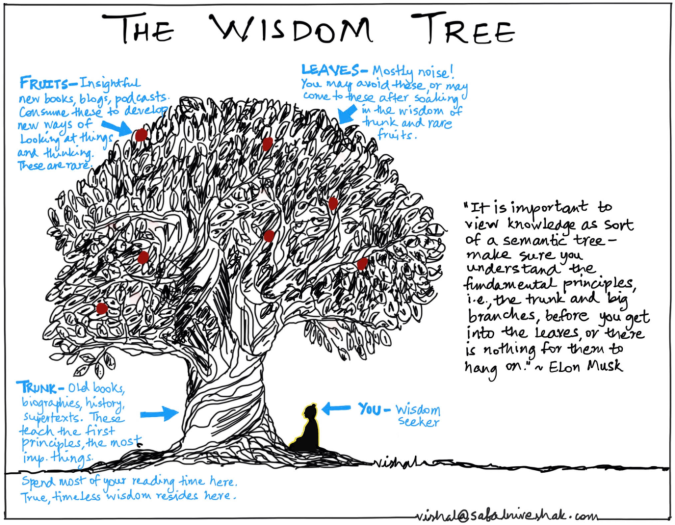
I’m intrigued by Elon Musk’s concept of Tree of Knowledge. He says, “it is important to view knowledge as sort of a semantic tree — make sure you understand the fundamental principles, i.e., the trunk and big branches, before you get into the leaves/details or there is nothing for them to hang on to.”

Vishal Khandelway created a helpful illustration to explain the difference between the trunk, branches, and leaves.

The trunk. Start here and build your foundational principles by reading biographies, history books, philosophy and other non-fiction.

The branches. These are podcasts, medium posts, new best seller books on Amazon, Op-eds in the Atlantic, NYT, Washington Post, etc.

The leaves. These are random tweets and Facebook posts. Back in the age of newspapers, these used to be Letters to the Editor. These are mostly noise.

Spend your time on the trunk and the branches. The leaves are seductive but don’t build help your build foundational principle that acts as your guidelines for making decisions.

Screen Shot 2018-01-11 at 2.55.57 PM.png

Always start with your principles.

Manage the downside

Seasoned risk takers manage the downside. When they fail, it’s never a knock out blow.

It’s like landing a plane on fumes, even if the final path to landing is a slow glide down to a makeshift runway. They pick the bailout area along the way, and if things don’t go to plan then they divert, land, refuel and regroup.

Increase your risk profile, but also increase the hedge against absolute failure. What’s your contingency plan, how do you mitigate loses? Don’t close your eyes, hit, and hope. That kind move only works in the movies.

Success is about persistence and repetition, but you can’t compete if you’ve crashed and burned along the way.

Compounded benefits

Nine women can’t make a baby in one month. It’s an overused phrase in business, but it’s still a goodie. The sentence is typically a response when someone on the project team asks if more people will accelerate the timing of the project. More doesn’t always equal faster.

Got a beach holiday planned this summer? Doing 200 sit-ups the day before you hit the beach isn’t going to get you that flat tummy. You’ll probably strain a back muscle in the process though.

Want to get a clean bill of health during your annual physical? Staying off sugar, not drinking booze and cutting back on red meat for one week before the blood test isn’t going to help your cholesterol levels.

Are you saving for retirement? Living large and waiting for a liquidity pop or a lottery ticket to play catch up when you are older is a risky move.

Some things you have to do every day. Slow and steady. Be patient and find joy in the day to day rituals. Most things in life compound over time. Start with a little bit every day, and it’ll grow over time.

Mushin

The difference between the first time you do something and the next time is incredible. Muscle memory kicks in after a couple of times. Repetition increases confidence and creativity, and it’s easier to get into the concentration flow. With enough repetition you don’t think anymore you just do. In martial arts, this mind state is called Mushin. It comes from the term mushin no shin which means the mind without mind. This flow state is possible anywhere whether it’s hiking, exercising, working, playing. Rinse and repeat.

When the going gets tough

Take one day at a time. The sun always comes up the next day.

You can only connect the dots looking backward. There will be time for retrospectives later. Now is the time for action.

Over-communicate, don’t bottle it up. Sometimes verbalizing a fear is like slaying the imaginary dragon. Other people will also give you perspective and shared experiences.

Ask yourself how you will feel about this two years from now. It’ll put things in perspective.

Separate what’s out of your control but don’t ignore it.

Worry and stress about things that are certain. Don’t spend energy on worrying.

Ask for help and share the load. Family, friends, co-workers will surprise you.

Stick to your principles and maintain integrity. People will know, and more importantly, you’ll know that when the pressure was on, you dared to be true to yourself.

Take a few deep breaths and check out for a bit. Try to get some sleep and exercise. Sleep and exercise compounds and is a magic stress reliever.

Stay off the coffee and booze.

Keep moving forward and don’t put your head in the sand.

It could be worse.

Keep tinkering

Persistence is a talent. I was at a talk the other day where a middle school teacher explained that her most successful students at the school were not the academically brightest, but the most curious and persistent. When I look back at my childhood and fast forward to where I am now, most of my school peers who’ve done beautiful things in life were the kids in the back of the class who were quietly tinkering on projects or were going deep on hobbies, sports, and extracurricular activities. They were working on things that didn’t offer up easy wins but were rewarding over time. They have taken that same skill in life and applied to business or academia. Persistence is the common theme.

Screen Shot 2017-12-07 at 6.47.37 PM

Seven habits of highly productive giving

Here’s a useful HBR piece co-authored by Adam Grant and Reb Rebele on how to beat generosity burnout. The theme throughout the article is that you need to be a warrior advocate for yourself if you are going to sustainably share your time, energy and experience.

I grabbed these 7 points from the article on how to be a productive giver.

7 Habits of Highly Productive Giving
  1. Prioritize the help requests that come your way — say yes when it matters most and no when you need to.
  2. Give in ways that play to your interests and strengths to preserve your energy and provide greater value.
  3. Distribute the giving load more evenly — refer requests to others when you don’t have the time or skills, and be careful not to reinforce gender biases about who helps and how.
  4. Secure your oxygen mask first — you’ll help others more effectively if you don’t neglect your own needs.
  5. Amplify your impact by looking for ways to help multiple people with a single act of generosity.
  6. Chunk your giving into dedicated days or blocks of time rather than sprinkling it throughout the week. You’ll be more effective — and more focused.
  7. Learn to spot takers, and steer clear of them. They’re a drain on your energy, not to mention a performance hazard.

Enjoy the article.

Authenticity scarcity

With the age of automation in full swing, we will be interacting more and more with software and hardware over humans. It’s an exciting time. Michael Fassbender’s role in Prometheus is a perfect example how androids will help older people on a daily basis. I also like the idea of TARS in the movie Interstellar. We’ll see the same trend in mobility, healthcare, finance, childcare, teaching, and sex. It’ll happen really slowly and then super fast. Humans will come to depend on AI the same way that we depend on family and friends.

With the tsunami of AI and Android assistance, people are going to lose touch with other humans. It’ll be possible to spend years alone with Androids and not see or touch another human. It will be like the space travel we see in sci-fi flicks where explorers live in space capsules protected from the harsh outside environment. These capsules will start to pop up on earth…first in hospices, then schools and then homes.

Over time people are going to crave real-life interactions again. There will probably be vacations zones and place that are Android free and zero technology zones. People will pay a premium for the imperfection of humans, whether it’s screwing up a food order, a casual conversation, while waiting in line, or brushing past someone on the bus. Things we take for granted or shy away from today, will be paid for and cherished.

Real life, authentic interactions will be something our grandkids only read about, but never experience. This thought makes me thankful for what I have today.