This tweetstorm from J.K. Rowling has inspired me to hit 
Here’s the original tweet. She’s a great person to follow on Twitter.
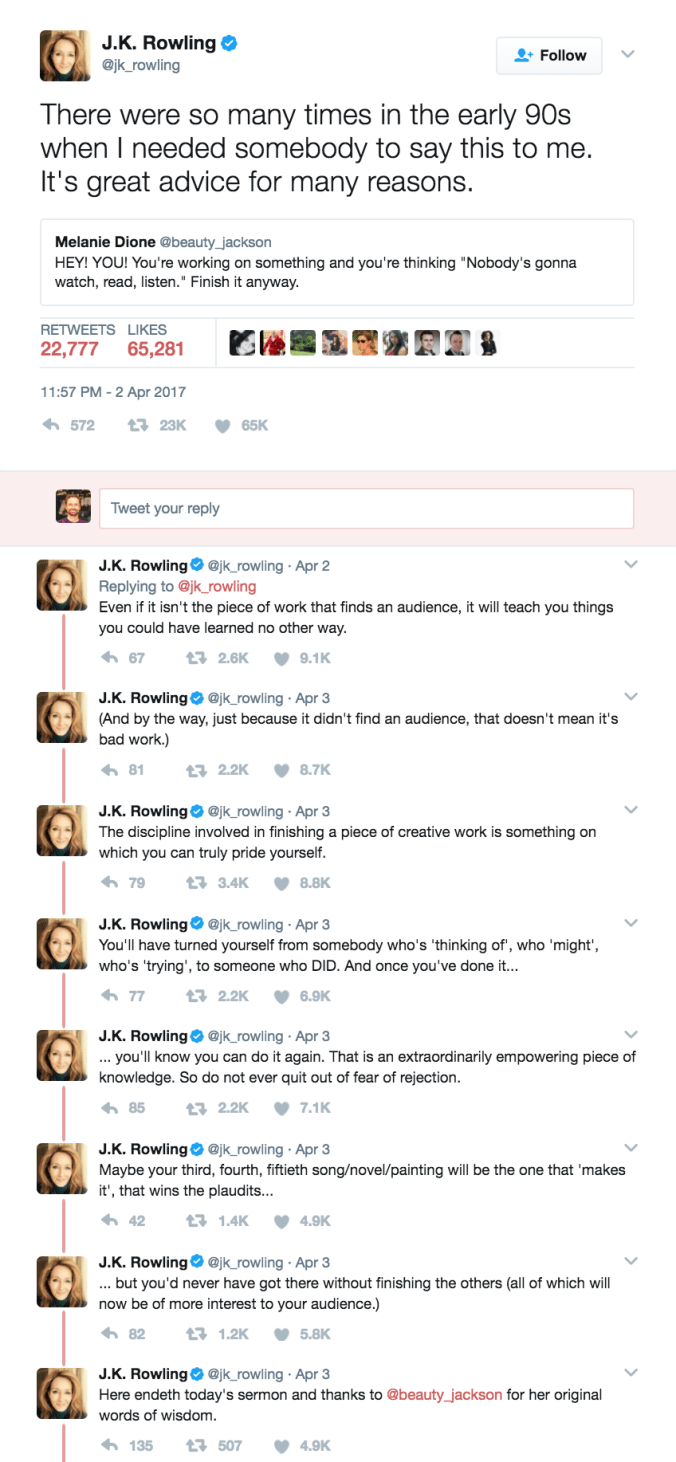
This tweetstorm from J.K. Rowling has inspired me to hit
Here’s the original tweet. She’s a great person to follow on Twitter.
The word of the day: NOW!
The best time to plant a tree is 10 years ago. The next best time is NOW!
Nature is everywhere. A sidewalk tree, leaves underfoot, moss in the cracks, flocks of pigeons, solitary hawks and noisy seagulls.
Feel the wind on your face. Open up your senses to it and you’ll realize that nature is all around you.
Yoga is the meeting of mind and body. It’s a way of life. Being in a studio with like minded people is a powerful way to practice. But what happens when class is over and you plug back into the life’s demands and pressures?
When class is over, lie down in Savasana – lie on your back, with arms and legs are spread out like a snow angel, close your eyes and breath deeply. Relax and let your mind wander. Unchain the brain. Imagine letting a dog off the lead at the beach and watch it sprint towards the waves – your brain will react in the same way.
After a while, slowly standup and re-engage with the sights and sounds of the day. Your next moves set the tone for the rest of the day. A lot of people jump up, crumple up their mat and hurry out. I do it from time to time too when I’m distracted, anxious and am already living in the future.
Stay in the moment and set the tone with how your matt is rolled: Stand up straight after savasana, relax the shoulders and jaw. Now tighten your tummy and bum, and do a slow forward bend towards your mat. Pick it up from one end and start to roll it. It doesn’t have to be at a snail’s pace, it’s about the intention to focus, do a good job. Rolling the mat keeps you in the yoga mindset, and makes you focus on the task at hand. It gets you out of your head, stops you from checking the phone or thinking about the next thing waiting for you. It also prepares you for the next class with a nicely rolled mat and makes set up for the next class easy.
Roll up the mat after class and continue the yoga outside of the studio.


The iPhone now has a low power mode setting. Switch it on and you disable your phone’s most higher energy features. It switches Mail from push to fetch, turns off automatic downloads and disables background app refreshes. In low power mode you get to choose where and when you expend your phone’s battery energy. It’s an underrated feature and I use it all the time, even when my battery is fully charged. Instead of calling it Low Power Mode, I call it Low Energy Suck Mode
Do the same thing with your mind and body. Activate Low Energy Suck Mode today. In this mode, you decide where and when to spend your time and energy. It turns off those coffee meet ups you should say no to and says no to people who guilt and manipulate you into giving up precious time with family and friends. Low Energy Suck Mode preserves your energy so you can decide when you choose to direct energy at someone or something. Your energy is sacred and you need protect it. When focused and at full power it’s loving and wonderful.
Activity Low Energy Suck Mode today. You’ll have more energy at the end of the day and less drag from things you don’t need.


Teddy Roosevelt said, “The first requisite of a good citizen in this Republic of ours is that he shall be able and willing to pull his weight.” A Good Citizen properly fulfills his or her role as a citizen.
A mercenary takes part in a battle, but is not a national or a party to the conflict and is motivated to take part in the hostilities by the desire for private gain.
People, not product, will determine the success or failure of a company. You can have an excellent product and fail because you’ve assembled the wrong team. Building a business at scale is hard. It’s fraught with uncertainty, highs, lows, wins and losses. It’s an emotional roller coaster. Good citizens roll up their sleeves when there’s work to be done. They pitch up every day and are in service to each other. Mercenaries leave if it’s about anything but themselves.
The list of GC attributes I look for when building a team:
Compassionate
Collaborative
Curious
Comfortable with uncertainty and mystery. They feed off it and enjoy it
Cocky in a kind way
Gritty
Impatient
Kind
Loyal
Persistent
Pragmatic
Polite
Persuasive
Zen
Pointers for spotting a GC:
They use ‘we’ and “our” a lot when talking about solving problems
They laugh at themselves
Pedigree & degrees don’t matter. It’s about what you can offer now and in the future
They have a history of execution and getting things done
They listen more than they speak
They are self-aware
They are black belts in verbal judo. The best answer always wins the tussle
They ask for feedback, welcome it, and act on it
They have detractors. Probably a couple of bullies they’ve stood up to in the past
They respect the people they work with and are friends with them
They are rewarded and recognized by their peers
They offer up reference checks from peers and previous investors/partners
They treat interviews like a two-way street and ask questions about the team, motivations and product
They seek you out, vs. running away from their current role or company
They have hobbies outside of work
Ad hominem is not an option
They are comfortable making decisions with incomplete data
The understand the importance of luck, timing and preparedness
They are always learning, experimenting, tinkering & tweaking
Titles don’t matter
So what’s the opposite of a GC?
In my experience it’s the Mercenary. The are seductive, because they get things done, but don’t be fooled – when the going gets tough and it’s time to contribute to the greater good and sacrifice something…they leave.
Attributes that pop up time and time again:
Bully
Blamer
Bitter
Charming
“Lone wolf”
Rude
Short tenures and long stories
How to spot them:
They use “I” and “they” when describing their current role and company
They describe past and present colleagues as ninkanpoops/clueless/tone deaf/opaque/idiots/blind/wrong/lazy
They hold grudges
They “get things done” through coercion and intimidation
They stereotype people and roles
They don’t believe in luck and good timing. It’s all about talent & A players
They are “Remember whens” – “remember when” is the lowest form of conversation. They dwell on the past, live in the world of what was instead of understanding that things change and you need to move forward. (The Sopranos Season 6, Ep 15)
Listen for phrases like:
They don’t listen to me
It’s them not me
I don’t have the resources
It’s not my responsibility
You need me
I inherited that problem
My team wasn’t big enough
They wouldn’t promote me
I told them, but nobody listened
Give me people a chance to change
Everyone can change, and I’ve seen it happen many times. Sometimes Mercenaries become GCs and even inspiring presidents, but if it looks like a goat and sounds like a goat it normally is a goat.
Happy hiring!
From time to time I’ll be posting a guest piece. Today’s post is by Bill Gordon. Bill is a friend, mentor and soon to be my kiteboarding coach (he doesn’t know that yet). Thanks Bill.
* * * *
Every month I meet with a small group to focus discovering for each of us what is our purpose and mission and why we are here in this world?
Being practical people we also talk about how that relates (if at all) to “being successful” and the normal financial commitments we all have for such things as monthly house payments, utility and car payments, taking care of our families, etc.
After many useful discussions, and books, and journaling, I haven’t made as much progress as I’d like. However, this week I heard a talk from a man named John Ortberg who’s insights I found useful. I wanted to share these in case they help you get any closer to clarity around your mission and purpose.
The idea that I took away from the talk was that finding our Mission or Purpose has to do with finding the intersection of 5 key things. The 5 things are:
If you’ve been keeping a list of thoughts and ideas on where you might like to focus your time and energy, run those ideas through this list of 5 items to see if there is an answer around the 5 that makes sense to you (and if you haven’t been keeping a list, I encourage you to start).
I hope this gets you closer to finding your path and purpose!

 markbartels.org