Well known cool, deep watering holes normally have lots of crocodiles. Bad news for new crocodiles looking for a new home and thirsty impalas

Well known cool, deep watering holes normally have lots of crocodiles. Bad news for new crocodiles looking for a new home and thirsty impalas
Most people aren’t good losers, they are just good actors.
Gyms serve as an apt illustration of the Pareto Principle, where roughly 80% of the impact is generated by 20% of the inputs. A small core group consistently shows up to work out day after day, while the majority pop in for a quick squiz at the start of summer or fall and then fade away. The commitment and daily grind displayed by the regulars speak volumes. The discipline they exercise at the gym also extends to other aspects of their lives.
Arnold Schwarzenegger has often said that building muscle and achieving fitness objectives are long-term commitments that demand dedication and sustained effort. You can’t fake physical fitness; it’s a testament to your discipline, perseverance, and work ethic.
This pattern of discipline is observable in various life domains:

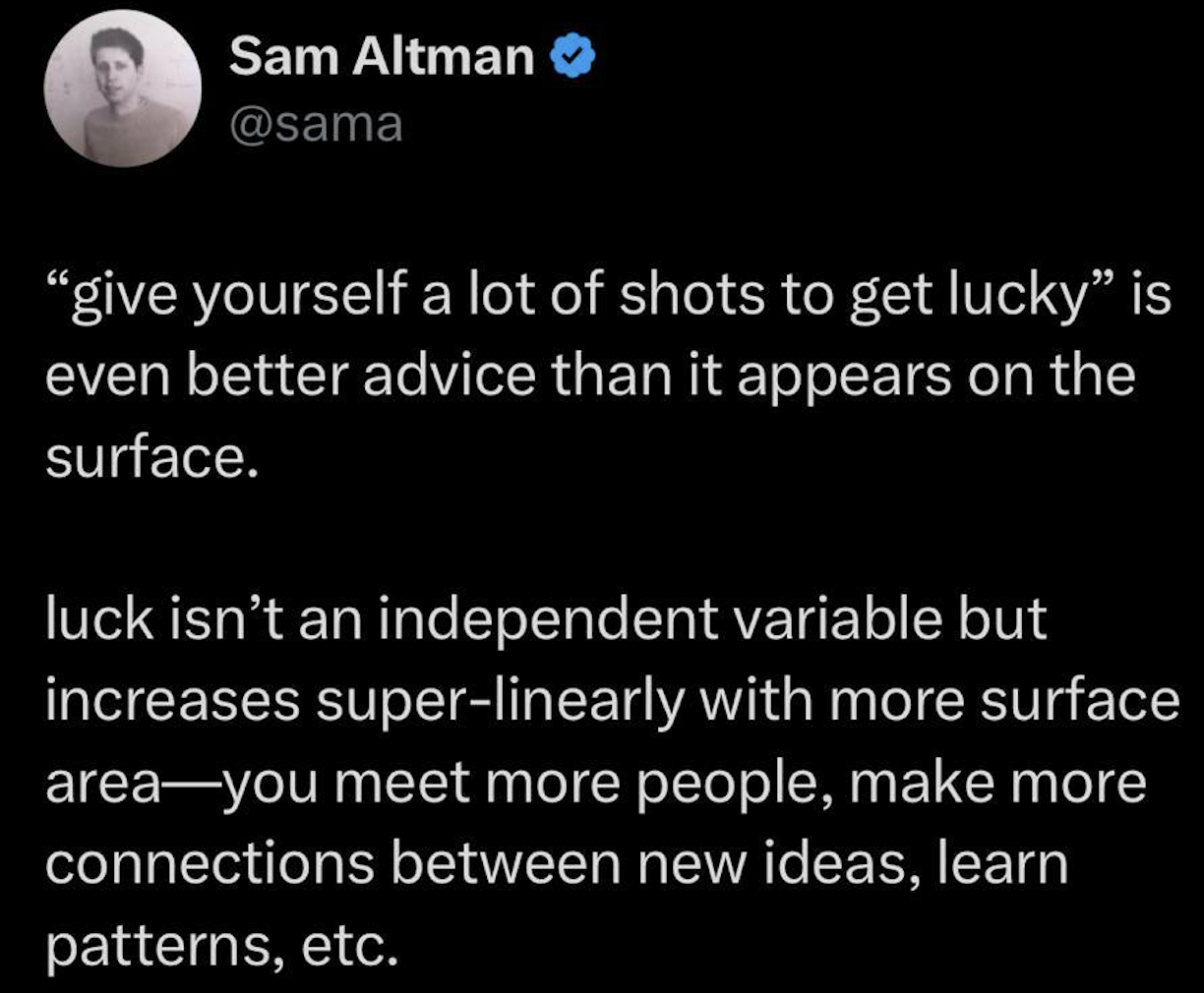
In places boasting high ‘serendipity scores,’ the likelihood of serendipitous and invaluable interactions is amplified. These chance meetings can blossom into new friendships, solidify partnerships, or spark stimulating conversations. The advantage isn’t solely in walkability; it’s also about the mixing of curious and motivated people that populate these areas. When these individuals collide, it paves the way for unanticipated moments of opportunity and insight. The design philosophies behind the Pixar Campus and the new Apple Campus resonate with this idea, juicing cross-pollination and facilitating organic learning.
While the tranquility and spaciousness of car-centric bedroom communities have their merits, they often fall short in offering regular serendipitous encounters. Hubs like San Francisco, New York, Sydney, pockets of London, and numerous bustling port cities worldwide stand testament to the irreplaceable value of being in an environment that nurtures such interactions.
The messy urban cities and the High Streets are where the alchemy happens.
Look for these 2 attributes in people when deciding to work with them or invest in them:
“Hard to kill” – Do they keep getting up even after getting knocked down multiple times? Do they persist and keep pushing forward? If so, these are the individuals you want to hire and entrust. Seek out their stories and anecdotes; their actions during challenging times, when the only way out was to persevere, will reveal their nature.
“Are they before the fall or after the fall?” – Has life humbled them, leading them to recognize that success, happiness, and progress result from a blend of hard work and luck? Despite adhering to rules and putting in the effort, life can deal with hardships—misfortune, illness, betrayal, accidents—that can be crushing in business, personal matters, and spiritually. But they get up and keep going. Hire those people because they have been humbled but kept going. You can normally see it in their eyes when you spend time with them.
I learned from an Invest Like the Best with Patrick O’Shaughnessy interview with James Griffon. Worth listening to here
As we look back on the last decade, there will be many books, podcasts, and lectures about the money made and lost and the lessons learned (and forgotten) from previous cycles. In the heady days of low-interest rates and excess cash, CEOs and investors were deified as having cracked the code, with a tour circuit of podcasts and social media posts evangelizing the latest metrics and formulas for success. Confidence was conflated with certainty, and hubris was at an all-time high.
If you can bear it, you should turn on CNBC and listen to ZIRP-era CEOs bang on about their companies performance. Most of their responses are scripted talking points. However, in 2023, we will see the return of seasoned operators who are in the details, understand the product, and get back to basics. Cash, profit, and positive cash flow unit economics will again be the focus, and the tried and proven artisans who focus on simple outcomes will rise to the forefront.
Despite the challenges of recent years, I’m excited to see the emergence of battle-worn, happy warriors who are humble, hard-working, and grounded in reality. They’re willing to grow, learn, and innovate while always focusing on the bottom line. Long live the king.
The idea of the court jester as a truth-teller has persisted throughout history. Today, comedians, poets, and social media personalities play a similar role, using humor and satire to weigh in on important issues and challenge the powerful in ways others may not be able to due to concerns about their livelihood or reputation.
The jester’s ability to speak the truth is made possible by their relative safety or anonymity. For example, anonymous social media accounts allow individuals to speak truth to power without fear of retribution, particularly in cases where powerful individuals are surrounded by sycophants and acolytes who may be unwilling to speak up.
Speaking truth to power can also have significant risks. In the past, court jesters who spoke out of turn or offended the ruling class could be executed to warn others that dissent would not be tolerated.
Today, when comedians, poets, and artists are silenced or punished for expressing dissenting views, it warns that those in power may not be willing to hear the truth. It’s a reminder of the importance of free speech and the need to protect those who speak out against the status quo.
Despite the evolution of the court jester’s role, the core responsibility of being a truth-teller remains the same. Whether through comedy, poetry, or social media, the jester has the ability to challenge the powerful and speak the truth to those who may otherwise be shielded from it.
I recently listened to the Founders podcast by David Senra. He discussed insights from his re-reading of “Let My People Go Surfing: The Education of a Reluctant Businessman” by Yvon Chouinard.
One quote from the book related to falconry really resonated with me:
“Falconry requires you to be totally absorbed in the moment, to be one with the bird, to anticipate its every move. You need to train the bird without breaking its spirit. It’s the same with surfing, climbing, or any other sport. You can’t muscle your way through it. You have to be in tune with the moment. You have to let it flow.”
This quote emphasizes the importance of being fully present and connected in any activity, whether falconry, surfing, or even business. It highlights the value of proper training and preparation while reminding us not to brute force our way through challenges but to allow things to flow naturally.
Chouinard uses this analogy to explain his approach to running a business. He emphasizes the significance of nurturing a strong company culture, investing in employee training and development, and fostering a shared purpose and commitment among team members.
Anatole France once said, “To accomplish great things, we must not only act, but also dream; not only plan, but also believe.” This quote highlights the importance of having a vision and belief in oneself to achieve success.
Pessimists are often hesitant to start, always worried about potential failure or obstacles. They may have good intentions, but their negative mindset keeps them from taking action.
On the other hand, optimists are full of energy and excitement but can sometimes struggle to finish what they start. They may become easily distracted or discouraged, lacking the persistence needed to see their dreams through.
Realists are often practical and level-headed, but their focus on the present and immediate concerns can prevent them from reaching for the stars. They may miss out on opportunities for growth and expansion due to a lack of imagination and willingness to take risks.
Possibilists, however, embrace a mindset of possibility and believe that anything is achievable with hard work and determination. They have a vision for the future but also understand the importance of planning and taking action to turn their dreams into reality.
Adopting a possibilist mindset can unlock our full potential and help us achieve great things. We must dream big, plan carefully, and, most importantly, believe in ourselves and our abilities. With this approach, there are no limits to what we can accomplish.
When it comes to new technologies like artificial intelligence, genetics in medicine, vaccines, defense technology, and climate tech, there is often a great deal of uncertainty and risk involved. This uncertainty can trigger our primal brain, telling us to stay put and not take unnecessary risks.
While this may be a natural response, it can be counterproductive. Doing nothing and staying in our comfort zones can be a greater risk than stepping into the unknown and forging ahead. We miss opportunities for growth, development, and innovation by staying put and refusing to experiment.
The history of human progress is filled with examples of people who took risks and pursued innovation, even when it was uncomfortable or uncertain. From the invention of the wheel to the creation of the internet, humans have always been driven to push boundaries and explore new frontiers.
However, when it comes to new technologies like AI, important ethical, philosophical, and engineering questions need to be considered. As we saw in the film “Contact” with Jodie Foster, a panel of experts with diverse perspectives – including representatives from religion, the military, and Congress – can help us navigate these new technologies’ complex issues.
AI has the potential to revolutionize the way we live and work. Still, it also raises important questions about privacy, security, and the role of humans in a world dominated by machines. These questions cannot be answered by scientists and engineers alone. We need a multidisciplinary approach that brings together experts from various fields to help us understand the potential risks and benefits of AI and guide us as we progress with its development.
In the end, the success of AI will depend on more than just its technological capabilities. We must also consider the broader societal implications of this technology and ensure that it is used in ways that benefit all members of society, not just a privileged few. By bringing together a diverse panel of experts and engaging in thoughtful, nuanced discussions, we can build a brighter, more equitable future for all.
 markbartels.org