De-caedere

De in Latin means “off”, and Caedere in Latin means “cut”.

Decisions are necessary for life to go on. A cut is painful and scary, but it’s also a release. Penalty shootouts in the soccer World Cup are cruel to the losing side, but a decision has to be made to continue the tournament and proceed to the next round. The cut is cruel but necessary.

That’s why we agree to abide by legal judgements. Humans need closure to move on.

Decisions are a forcing function and push us out of no man’s land and onto the next thing.

Make the cut, don’t look back. Go.

Free of the future

The man hunched over his motorcycle can focus only on the present… he is caught in a fragment of time cut off from both the past and the future… he has no fear, because the source of fear is in the future, and a person freed of the future has nothing to fear – Milan Kundera

This is like surfing. The rush of the water underneath me, the feeling of lift as the wave picks me up and I plug into the flow of the stream. I forget if my fingers are numb or if my wetsuit has been chaffing my neck. All the internal dialogue is gone. Drowned out by the now. Muscle memory kicks in, and there’s no thinking. No woulda, coulda, shoulda. There is just doing. That’s freedom.

Courageous Chlorine pills

It’s only weird if you make it weird. You save so much time and energy if you cut to the chase.

If you are confused, then put your hand up. I’ll bet most of the people in the room feel the same way.

Ask the painful or uncomfortable question if something doesn’t make any sense.

Send a clarifying email if your first one was ambiguous

Give honest and candid feedback. It get’s awkward when you beat around the bush and usually results in more follow up.

The courage to speak candidly is like dropping chlorine pill into the murky water. Everyone will soon see clearly even if it means some red eyes.

He who loses wealth loses much; he who loses a friend loses more; but he that loses his courage loses all – Miguel de Cervantes

Open your arms and welcome what is running out to meet you

I heard this story at a graduation ceremony last month and thought it was worth sharing.

Poet David Whyte tells this story: At his home on Whidbey Island in the Puget Sound, he decides to host many friends for a weekend. As the guests begin to arrive, he stands at the door ready to greet them. Eagerly by his side is his young daughter, who has worked with him for many days to prepare the home, cook the appetizers, and clean her room. Yet as friends arrive, her shyness takes over, and she hides behind David, clutching his legs, peering through them and around them at times, smiling tentatively to different guests.

Whyte recalls seeing an old friend approach. Someone he says had, over the years, grown very cynical. Whyte describes cynicism as fierce disappointment that looks for further, future disappointed. A cynical person almost eagerly waits to be disappointed by others and by life.  As this old friend approached the door, David felt his daughter clutch his legs more tightly and crush her face into the back of his legs, not wanting to look out.  His daughter relaxed, and the man disappeared into the house. Soon after another of David’s old friend appears on the path, one who he describes as having a face that beams with warmth and generosity. David’s daughter, who had never met this man before flew from her father, ran down the path and jumped into his arms, where they proceeded to laugh and chat with great joy.

Later that day, David walked into his living room and saw this man sitting on one side of the fireplace, and his friend who had grown cynical on the other side. And he thought about his cynical friend, “He does not even know what has not run out to meet him…”

He does not even know what has not run out to meet him…

Be curious, be generous and expect the best from people.

Decision making using the cardinal virtues

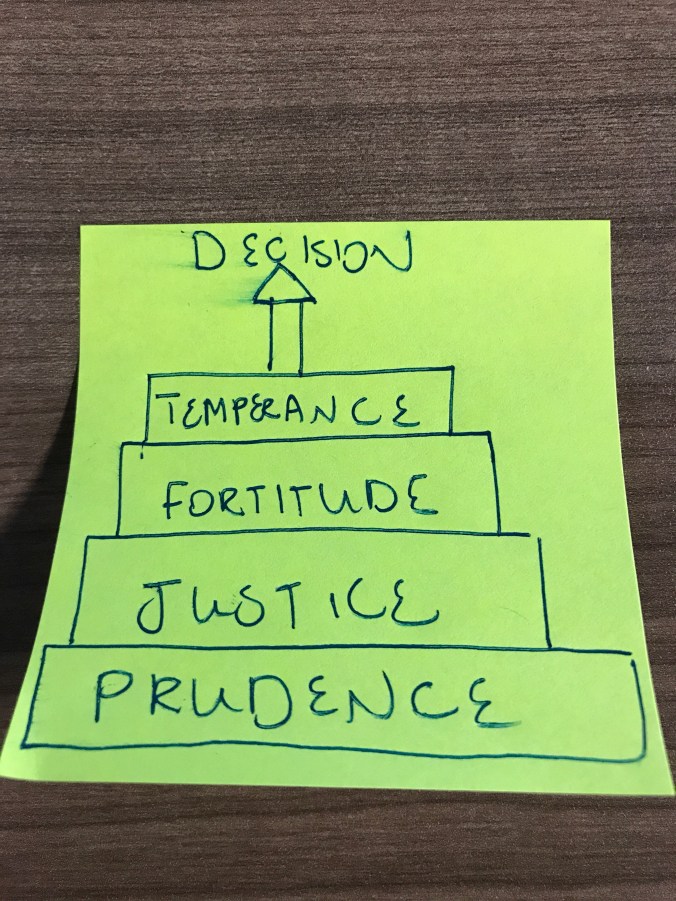
Use the four cardinal virtues as building blocks for making decisions.

Prudence is the base, followed by justice, fortitude, and temperance. The order is important.

1. Prudence: Do your due diligence, run the numbers, ask questions and build scenarios. Do the work and make sure the unit economics make sense.

2. Justice: So economics work, but is your idea or action just? The test is whether your concept or activities deny someone else’s rights. If they do, then it’s not just. That test includes yourself. Are you doing yourself justice? Your plan might benefit everyone else but be punitive to you. An example is the 2018 immigration debate in the USA. A well-secured border is prudent, but separating babies from their immigrant mothers at the border is not just.

3. Fortitude: Okay so you’ve ticked the two boxes. The idea is prudent and just, but do you have the fortitude or courage to follow through on your decision. None of the first two virtues matter if you can’t follow through with the idea.

4. Temperance: Don’t get carried away by your emotions because it’ll cloud your judgment. If you allow your feelings to hijack your decision once you’ve committed, then you’ll buckle or second guess yourself at the first sign of resistance.

Virtues never go out of style or reach their shelf life. The same principles that applied centuries ago are relevant today.

The courage to quit and the wisdom to persevere

There are four cardinal virtues for everyday life: prudence, temperance, courage and justice. Of all the virtues, courage is the most important.

Courage is rightly esteemed the first of human qualities… because it is the quality which guarantees all others – Winston Churchill.

The crowd rewards grit and persistence, but make sure your grit and persistent is in the right direction. Remember it’s a lot easier to get in than it is to get out.

Knowing when to quit a case and having the courage to follow through with an exit is sometimes more difficult than staying on the case with stubborn perseverance. Just like the stock market, most humans hold on too long on the highs and hold on too long on the lows. It feels safer to hold and wait. It takes courage to sell and walk.

Take a deep breath and have the courage to step into the mystery.

Ball machines are predictable

It’s easier to criticize or dole out advice than it is to do. If people don’t have skin in the game or consequences of a decision or actions, then their opinion doesn’t mean much. 

It’s the same as getting advice from a highly paid consultant who has never run a company day to day. Everything always looks simple and obvious when the outcomes are academic. Academic recommendations don’t factor in real-world dynamics that are unpredictable and filled with unknowns.

Getting academic advice on how to implement something in the real world is like practicing tennis on an indoor court with a ball machine. At the end of an intensive tennis training camp with the ball machine, I’m sure the error rate will be low, and the person will have a stable backhand. Now take that same person and put them on a tennis court in the middle of a sunny day with a breeze. See how their tennis game deteriorates when they are serving with the sun in their eyes and their opponent charges the net after returning serve. Ball machines are consistent and predictable. Real-life is the antithesis of predictable.  

Instead of asking for advice, ask for shared experiences and draw your conclusions. If a person doesn’t have any shared experiences with the task at hand, then press mute and move on.

Frontiers and Boundaries

I love the word frontier which implies exploration and boundary which implies being boxed in. It’s the difference between open and close, curious and close-minded, building a wall and opening a gate.

Cicero is believed to be the greatest speaker that ever lived. So eloquent that Caesar–often the victim of the man’s words and redresses–considered Cicero‘s achievements to be more significant than his own; once remarking that it was nobler to “extend the frontiers of the mind” than it was to the “boundaries of the empire.”

Watch what he does when he’s down

If you want to know how good someone is, then watch what he does when he’s down.

Does he put his head in the sand and ignore the problem? Does put his hands on his ears and drown out reality? Does he spend his time making a list of who is to blame? Does he run away? Does his reality distortion field get set to maximum strength?

Or does he knock on your door at 8am in the morning with 2 cups of black coffee, and ask how he can help? Does he roll up his sleeves and muck in? Does he admit that he needs help and take advice? Does he follow through and take responsibility when everyone else has run for the exits?

Choose wisely when working with people. When the pawpaw hits the fan…and it always will when you are building new stuff then who do you want by your side?


The Weirdo Rule

It’s taken me a long time to adhere to the Weirdo rule. Partly because I doubted myself and partly because I was too polite. I’ll still make the mistake of not following it in the future, but I’m getting better with each burn.

Here are some examples of the rule. You’ll get the gist.

When you have met someone multiple times in different settings, and he doesn’t remember your name. Each time he introduces himself to you as if it’s the first time he’s ever met you. A mistake would be to walk away thinking you must a very forgettable person. Wrong. This person is a weirdo. Zero EQ or social skills. Too self involved to notice.

You are having a conversation with someone, and it’s entirely one way. They asked for the meeting or initiated the conversation, but they offer nothing.  A mistake would be for you to keep talking. Maybe you are hard to understand or just boring them to tears? Nope. This person is a weirdo. Stop talking, Pause. There will probably be an awkward moment or two. Goodbye weirdo.

You ask for a rare favor from someone you’ve helped on countless occasions in the past. Your text or email goes unanswered. The next time you see the person they act as if they never saw the email. They’ve ghosted the whole interaction. Your email didn’t fail to send. It’s not still sitting in your draft folder. Their response didn’t go to your junk mail. In the past I would think I probably shouldn’t have asked for a favor, now I just stop helping the weirdo.

Have confidence in your intuition. Be self-aware. Follow up and give people the benefit of the doubt, but don’t start making excuses for weirdos. Life gets a lot more straightforward with this rule.

There is a catch 22 with this rule. You might be the weirdo, then you are screwed.